Private Consumption
Author(s):  A Mason
Last Revised:  December 13, 2005
Private Consumption (CF)
Private Education Consumption (CFE)
Private Health Consumption (CFH)
Private Capital Consumption (CFK)
Private Consumption Other (CFX)
Issues
- Adjustment of private consumption to exclude indirect taxes.
- Should private consumption that is heavily or totally subsidized by taxpayers be classified as public consumption. Examples are Medicare and Medicaid in the US and National Health Insurance in Taiwan.
Defining and measuring private consumption
Private consumption consists of household consumption and consumption by non-profit institutions serving households (NPISH). Three adjustments to NIPA values are necessary.
- NIPA counts expenditures on consumer durables as current consumption. The preferred NTA approach is to count expenditures on consumer durables as investment and the flow of services over the useful life of the durable as current consumption. Hence, expenditures on consumer durables should be subtracted from NIPA consumption and an estimate of the flow of services from consumer durables should be added to NIPA consumption. Note that NIPA and NTA both treat the purchase of housing as investment and the flow of services as consumption. The flow of services from durables and from owner-occupied housing is Private Capital Consumption (CFK).
- NIPA consumption includes indirect taxes on consumption, e.g., taxes on retail sales. NIPA consumption should be reduced by the value of indirect taxes on consumption. The public sector methodology discusses taxes and their incidence in more detail.
- NIPA defines public consumption as the values of goods and services purchased by general government. If individuals purchase goods and services and are reimbursed by the government, the values of those goods and services are classified as private consumption by NIPA. A proposal to reclassify health expenditures reimbursed through government programs as public consumption is being considered.
Four components of private consumption are distinguished:
- Private education consumption (CFE) includes tuition, books and fees, school supplies for all school levels including pre-school and tutoring expenses. The exact definition will vary depending on data availability. In Taiwan, reference materials and self-improvement classes (art classes, music classes, etc.) are also included.
- Private health consumption (CFH) includes out-of-pocket health expenditure and reimbursement to health providers by private health insurance companies. If firms provide medical services directly to their employees and their dependents, the value of these services are also included in private health consumption. Whether health consumption reimbursed by public cash transfers is to be counted as public or private health consumption is under discussion.
- Private capital consumption (CFK) is equal to the imputed rental value of owner-occupied housing and the flow of services from consumer durables.
- Other private consumption (CFX) is the value of all consumption otherwise not estimated.
We need a paragraph here explaining where we get the macro controls for each of these components and how each component is adjusted
The tasks involved in the analysis are:
- Construct measures of household consumption that conform to the consumption components identified above.
- Assign consumption values to each individual using allocation rules described below. All consumption is allocated to individual members.
- Tabulate the data using survey weights to obtain per capita age profiles of each consumption component.
- Smooth per capita profiles to eliminate noise.
- Multiply per capita profiles by final population estimates to obtain aggregate age profiles for each consumption component.
- Adjust the aggregate age profiles and the unsmoothed and smoothed per capita profiles proportionately to match the aggregate contol total.
- Upload the unsmoothed per capita age profiles, the smoothed per capita age profiles, and the aggregate age profiles to the NTA database.
Each component of consumption is analyzed separately and then aggregated to determine total consumption.
Constructing Age Profiles
The methods described here assume the availability of one or more household surveys which include detailed expenditure data for the household and the number and age of all household members. Ideally the surveys are nationally representative.
Household expenditure surveys usually include all household expenditures or outflows. Although only consumption expenditures are needed to estimate consumption age profiles, other outflows are used to estimate age reallocations. Thus, it is useful to classify all household expenditures or outflows during the year as falling into one of three categories - consumption, transfers, or asset reallocations:
| Consumption | Transfers | Asset R. |
| Food, clothing, house rent, etc. | Tax payments | Residual |
| Rental value of owner occupied housing | Gifts | Interest payments |
| Flow of services from durables | ... | ... |
Several important points should be noted. First, housing consumption for a household residing in a home that it owns is the value of the annual services that home yields typically measured as the amount for which the home could be rented. The purchase of a home is a component of saving and investment. Second, consumer durables should be treated, in principle, in the same way as housing. Consumption is the value of the services from the durables. The purchase of the durable is also classified as saving.
Household expenditure surveys typically report the rental value of owner occupied housing. Whether or not consumption of durables can be measured as a flow rather than a purchase will vary from country to country. Estimation details for the US are provided in Tim, do you have something here?
The following items should be classified as transfers and not included in consumption: tax payments, gifts, remittances, donations, and similar items.
The following items are classified as asset reallocations and not included in consumption: the purchase of a home; the purchase of consumer durables; the purchase of stocks, bonds, and other securities; investment in a business or farm; increases in cash holdings; interest payments; land rent. Expenditure surveys will vary in the extent to which these items are reported. Often saving is estimated as a residual, i.e., income plus net transfers less consumption.
Some items require particular attention although they may be unimportant in some countries or data may limit the extent to which they can be treated.
Insurance. Some insurance premiums (whole life insurance) are a form of saving. Consumers pay a premium and their policy accrues value that can be cashed in at a later date or borrowed against. This is saving. Other forms of insurance provide consumers with a way of pooling their risks. Term life insurance and property and casualty insurance are examples of these forms of insurance. Some portion of premiums collected each year are paid to beneficiaries who have experienced the particular event being insured. These payments are transfers. Although they may produce interage reallocations, we assume that premiums are assessed in an actuarially fair way and, hence, produce only intra-age reallocations. The remaining portion of premiums paid by consumers defer administrative costs and profits of insurance companies. This amount represents the cost and value of the risk-pooling services provided by insurance. It is classified as consumption by NIPA and by NTA.
The US NIPA have recently been revised because catastrophic losses, e.g., those produced by Hurricane Katrina, lead to large fluctuations in insurance related components. The new revisions will measure the consumption of insurance services using an estimate of normal profits. Catastrophic losses that lead to actual profits that differ from normal profits are treated as a transfer. More details of the US revision are described in http://www.bea.gov/bea/faq/national/insurance_services_gdp.htm
The key issue for estimating NTA consumption is using household survey data to define consumption in a way that is comparable to NIPA consumption and its components. Household consumption expenditure would include a portion of insurance premium expenditure with that portion determined by the share of insurance in NIPA consumption.
Health. In NIPA private health consumption includes the values of all goods and services that are marketed, i.e., goods and services purchased from either private or public providers. Public health consumption includes only goods and services that are provided as in-kind transfers. Examples are the subsidized portion of public innoculation programs, public sanitation programs, free clinics, family planning programs, etc. Private consumption includes goods and services purchased and reimbursed through public cash transfer programs. Health consumption reimbursed by Medicare and Medicaid in the US and by National Health Insurance in Taiwan are classified as private health consumption in NIPA.
The allocation of private health consumption is difficult because of the complex ways in which it is financed. Three sources of finance are important in many countries: private out-of-pocket expense, private insurance, and the public sector. Different age allocation methods may be required for each of these components of health consumption. National Health Accounts (NHA), available in some countries, provide a useful breakdown by source of finance. Recent estimates for the US and a detailed discussion of the methodology employed for construction NHA in the US are available at:
http://www.cms.hhs.gov/statistics/nhe/definitions-sources-methods/
There are important differences between NHA and NIPA that should be kept in mind. First, NHA document expenditures rather than consumption. Expenditure is a broader measure that does not distinguish consumption from investment and profits. Private health expenditure, for example, includes the profits of insurance companies. Second, public national health expenditure in NHA includes both in-kind and cash transfers.
Separate procedures are used to allocate education, health, and housing and other consumption to household members. The methods described are intended as illustrative and should be adopted to the particular circumstances of the country being analyzed and to the particular data that are available. The method of choice is to rely on individual level data for any consumption component, but these are rarely available.
Allocating Education
Education is allocated using a regression model. The household consumption of education () is regressed on the number of household members in each age group enrolled in school (
) and the number of household members not enrolled (
):
Note that this equation is estimated in homogeneous form (without an intercept) insuring that household consumption is fully allocated. The age groups included will vary with the country and its enrollment rates. In Taiwan, the number of enrolled members includes those aged 6 to 29. The number of not enrolled members includes those aged 3-7 and 30+. The number of members not enrolled captures educational spending that is not part of the formal educational system.
Allocating Health
The method used to allocate health varies depending on the availability of data. In Taiwan, health is also allocated using a regression model. The model is simpler than the model used for education because there is no variable that capture which individuals are receiving health care services. Hence, household health expenditure is regressed on the number of household members in each age group ():
Again, the model is estimated in homogeneous form (with the intercept supressed). The age groups can be single year or in broader age groups. For some age groups, out of pocket health spending might be very small and estimated coefficients may be negative. Health spending on these age groups can be constrained to zero.
The regression estimates are used to allocate the health expenditure for each household j to household member i using:
where x is the age of the ith household member.
Allocating Owner-occupied Housing Consumption and Other Household Consumption
Other household consumption is allocated to individuals using an ad hoc allocation rule based on an extensive review of the literature and other estimation methods, e.g., Engel's method and the Rothbarth method.
Consumption of individuals living within any household j is assumed to be proportional to an equivalence scale that is equal to 1 for adults aged twenty or older, declines linearally from age 20 to 0.4 at age 4, and is constant at 0.4 for those age 4 or younger.
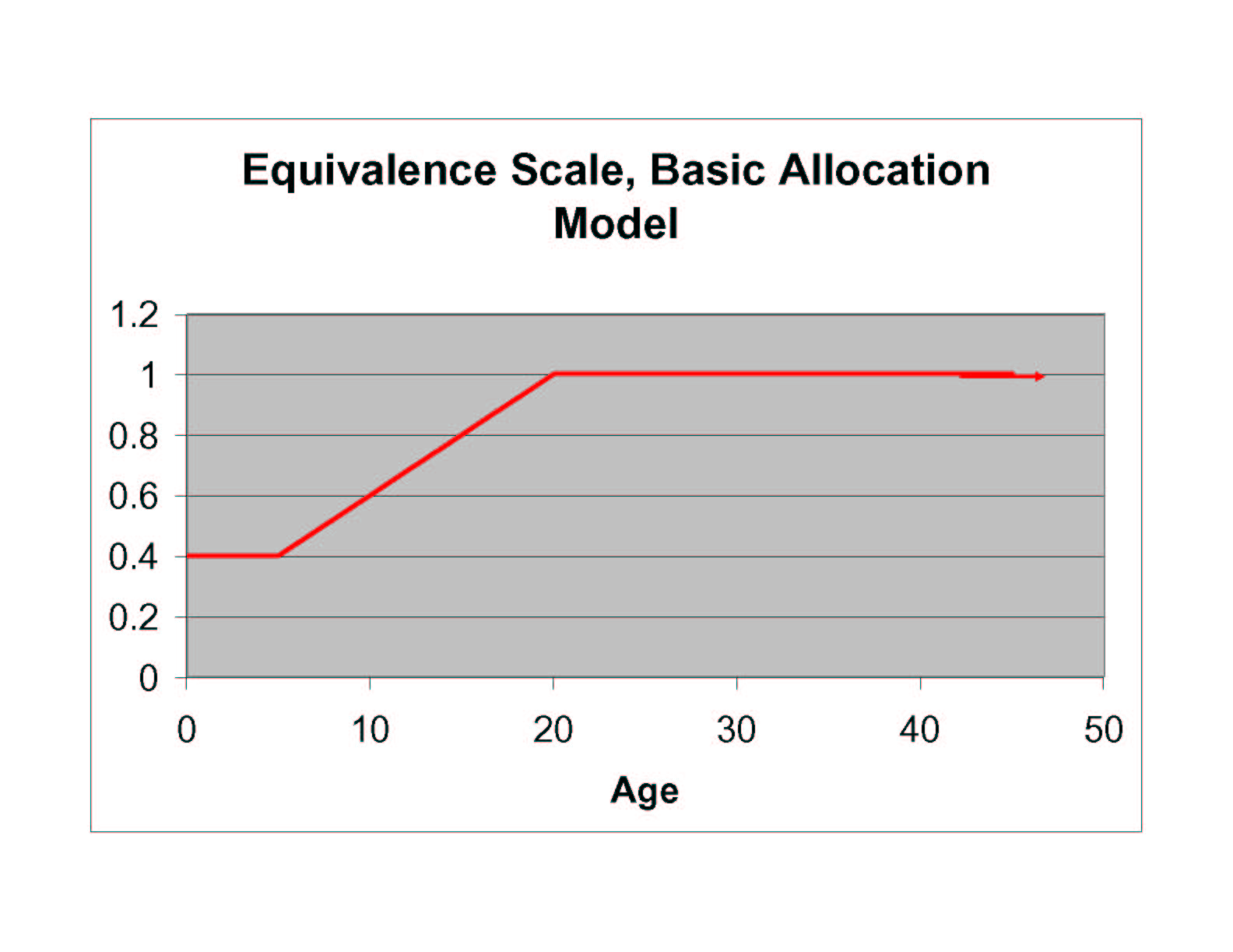
A formula for the scale:
where x is the age of the ith household member.
Smoothing
Methods and guidelines for smoothing are described in Smoothing. Important point: Education consumption is intrinsically not smooth and the best approach is often to use the unsmoothed age profile to construct final estimates. It may be advisable to smooth at older ages, however.
Sample Code
The code used to estimate private consumption profiles for Taiwan using Stata are contained in the following files: Education Code, Health Code, and Other Code.
Comments about the Private Consumption methodology: